

Asset Management with ASAM ODS – Creating a Holistic Data Space for the Digital Twin.
The core idea of this proposal is to combine IDTA Asset Administration Shell (AAS) information with physical testing data stored in ASAM ODS.
[In der Blog-Übersicht wird hier ein Weiterlesen-Link angezeigt]
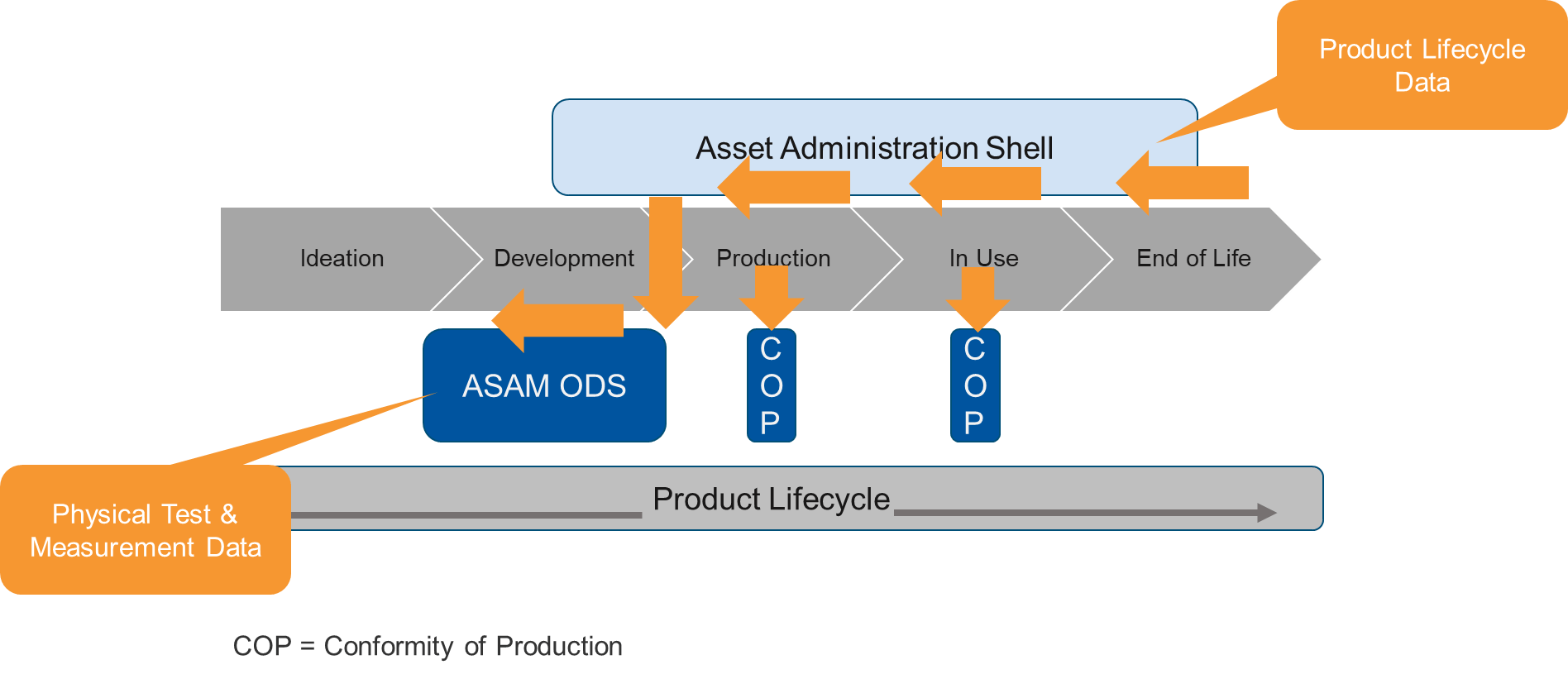
This integration creates a comprehensive data profile spanning the entire product lifecycle—from early development through end-of-life and beyond. The resulting data space enhances:
- Standardization
- Data interoperability
- Industrial digital twins
By linking product lifecycle information (AAS) with detailed physical testing results (ODS), companies can significantly improve their capabilities in
- Predictive maintenance
and reduce time and cost associated with
- Product improvement
- New product development
A key advantage of this approach is that it not only considers the lifecycle data of the final product but also integrates R&D data the pre-production phase. This includes insights into alternative materials or components that, while not part of the original product version, could be valuable for future options or redesigns. Additionally, data from existing products can be reused as the foundation for new products, thereby minimizing the need for repeated component testing based on previous validation work.
By combining AAS gateway capabilities with ASAM ODS test and measurement data—along with detailed information about the device under test, the test equipment, and the test sequences— this approach significantly supports the IDTA vision according to which the AAS forms the foundation of the Industrial Digital Twin.
You can find this presentation available for download here:
This proposal was presented at the ASAM Technical Seminar 2026. All presentations are available for download on the ASAM Technical Seminar Website.
Connected solutions
You can click on the links to get more information about the individual components
Peak ODS-Server
Long term data storage including APIs for standardized and secure data access
Peak ASAM ODSBox
Lightweight Python Toolkit for Seamless ASAM ODS Data Access and Analysis
Peak ODS Adapter for Apache Spark
Scalable data access based on Apache Spark.
