


The Hidden Costs of Poor Test Data Management in Engineering
Repeated testing, lost engineering time, inconsistent decisions and AI projects built on unreliable data. The real cost of fragmented measurement data goes far beyond storage.
[In der Blog-Übersicht wird hier ein Weiterlesen-Link angezeigt]
Repeated testing, lost engineering time, inconsistent decisions and AI projects built on unreliable data. The real cost of fragmented measurement data goes far beyond storage.
[In der Blog-Übersicht wird hier ein Weiterlesen-Link angezeigt]
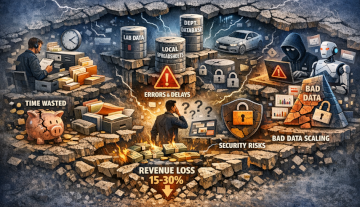
Test and measurement data has become a strategic engineering asset. Every day, development labs, test benches, proving grounds and simulation environments generate vast amounts of information. Yet this data is often fragmented across file systems, proprietary tools, local databases and department-specific solutions.
The result is not simply inconvenient data storage. Fragmentation can lead to repeated test campaigns, delays in engineering decisions, inconsistent results, limited traceability and lost opportunities for innovation.
What are test data silos?
Test data silos emerge when measurement and validation results remain isolated in file servers, proprietary tool environments, department-specific databases, local spreadsheets or scripts — often with inconsistent metadata.
These approaches may work well within one team. Across an engineering organization, however, they make it harder to:
- Find and reuse previous test results.
- Compare measurements across projects and test campaigns.
- Preserve the technical context needed for long-term interpretation.
- Control access to sensitive development information.
- Make trustworthy data available for analytics and AI.
Four hidden costs of fragmented test data
Most organizations see the direct costs of testing. The indirect costs of poor data management are less visible — but can accumulate across engineering departments.
- Engineering time lost to data preparation: Engineers spend valuable time searching, cleaning, converting and reconciling measurements instead of analyzing results and solving technical problems.
- Errors and repeated validation: Missing or contradictory metadata creates uncertainty, faulty comparisons, repeated validation loops and delays in technical release decisions.
- Security and compliance exposure: Without centralized visibility, organizations struggle to determine who has access to which data, how changes are controlled and whether evidence remains auditable.
- Scaling poor data quality with AI: AI agents and analytics workflows cannot compensate for unreliable metadata. Without a trusted foundation, they risk spreading mistakes into dashboards, reports and decisions.
Even when individual inefficiencies appear small, they can add up across many teams and test campaigns. In testing environments, repeating an expensive physical test because earlier data cannot be found or interpreted is a particularly costly example.
The well-known 1-10-100 rule states that the cost of fixing a problem increases approximately tenfold at each subsequent stage: prevention is cheapest, fixing is more expensive, and ignoring is very costly. In test environments, this means, for example, having to repeat time-consuming physical tests – simply because previous data is no longer findable or interpretable.
From isolated data to controlled collaboration
Solving this problem requires more than a shared folder or a new analytics tool. A modern Test Data Management platform creates a consistent engineering data foundation, while allowing engineers to continue using their existing measurement and analysis environments.
Peak Test Data Manager (PeakTDM) supports this approach through:
- Integrating test data from heterogeneous sources and formats
- Harmonizing metadata and ensuring long-term interpretability
- Enabling findability across departments and toolchains
- Implementing role-based access control and governance
- Supporting auditability and compliance requirements
- Connecting test data to Python, analytics platforms, and AI agents
- Reducing shadow IT and uncontrolled data copies
Rather than replacing established test and analysis tools, PeakTDM connects them through standardized data models, access mechanisms and governance processes.
The strategic perspective: data as a reusable asset
Test data should not be treated merely as documentation of completed experiments. With sufficient metadata and clear governance, it becomes a reusable knowledge asset that supports better engineering decisions across the product lifecycle.
Organizations that modernize Test Data Management can reduce unnecessary testing, increase collaboration across engineering domains, improve audit readiness, strengthen data security and create a more reliable foundation for AI-supported engineering.
Those that do not risk accumulating inefficiency, compliance exposure and technical debt — even as they invest in more advanced test systems and analytics platforms.
The question worth asking
Are your test data silos quietly consuming engineering capacity — through repeated work, hidden risk and missed innovation? Or do you already have a structured, future-ready data backbone?
If you want to assess the maturity of your current Test Data Management strategy, start by identifying where data becomes difficult to find, interpret, connect or govern.
Peak Solution helps organizations turn test data chaos into controlled, secure, and AI-ready insight.
Turn insight into action
Talk to Peak Solution about improving data accessibility, traceability, reuse and readiness for analytics and AI — without disrupting your established tools.
Connected solutions
The Right Components. The Right Solution. For Your Engineering Challenges.
Peak Test Data Manager
Stop searching for test data. Start turning it into engineering value. Transform scattered measurement data into a trusted, accessible, and AI-ready engineering asset
