


Peak Test Data Manager Meets Databricks: Building an AI-Ready Engineering Data Platform
CUSTOMER SUCCESS STORY
How a global automotive manufacturer connects trusted engineering data with enterprise-scale analytics and AI.
[In der Blog-Übersicht wird hier ein Weiterlesen-Link angezeigt]
The challenge: Turning engineering data into enterprise value
Successful engineering organizations invest in enterprise data platforms and artificial intelligence to derive insights from increasingly large and diverse datasets. Technologies such as Databricks provide the foundation for large-scale data processing, machine learning, and AI. However, scalable data processing and analytical infrastructure alone does not make measurement data understandable, traceable, or ready for reliable analysis.
Test benches, simulations and real-world testing produce data in heterogeneous formats, with different structures and domain-specific meanings. To interpret a measurement correctly, engineers need more than the raw signal: they need information about the test object, configuration, procedure, conditions and provenance. Without that context, combining datasets across sites and disciplines can become a costly, manual exercise.
The customer ambition
A major international automotive manufacturer set out to establish a centralized, globally accessible and trustworthy environment for managing and analyzing test and measurement data across physical and virtual test domains. The platform had to support global distributed engineering teams and different technical disciplines without forcing them into one rigid workflow or replacing their preferred engineering tools.
The strategic decision was to combine an established platform for engineering data management with a scalable enterprise analytics platform. Peak Test Data Manager (PeakTDM) - based on ASAM ODS - provides the necessary domain-specific capabilities and standardized access to test data, while Databricks delivers scalable processing and advanced analytical functions.
An architecture designed for reuse
Rather than recreating data ingestion, metadata management and tool interfaces for every new analytical use case, the project uses three complementary layers: a data layer, a dedicated integration layer and Databricks as the central analytics and AI environment. This division of responsibilities allows new test domains and applications to be incorporated over time, without having to reimplement core functionalities from scratch on each occasion.
The solution: Three complementary architectural layers
Layer 1 — Engineering Data Foundation: Peak Test Data Manager
PeakTDM establishes a distributed, multi-tenant foundation using the ASAM ODS standard and the openMDM application model built upon it. Thus, individual test domains can use their own metadata models and domain-specific functionality while benefiting from common data management principles. The architecture is designed to accommodate diverse engineering disciplines rather than imposing a single universal data model.
Configurable, monitorable ingestion pipelines integrate heterogeneous test data coming from different test environments, validate and harmonize the incoming information, and preserve its engineering context. Through a web interface, engineers can search, navigate and inspect imported datasets across tools, teams and sites. Standardized interfaces also let them continue using established tools for analysis and downstream processing.
The domain-specific data management applications are containerized and deployed in private cloud environments. This enables a consistent approach across geographically distributed operations while retaining the flexibility needed by individual test domains.
Layer 2 — Integration: Engineering Data meets Scalable Analytics
The Peak ODS Adapter for Apache Spark connects the data layer with Spark-based analytics, enabling retrieval of metadata and measurement data through Spark SQL and Pandas DataFrames. Depending on the use case, information can be accessed directly or supplied through configurable transformation pipelines.
This flexibility is important for large measurement datasets: original mass data can remain in the data management infrastructure while selected subsets, derived characteristics or analytical features are made available for further processing. The integration layer can also support AI applications through the Peak AI Connect MCP Service, allowing intelligent agents to locate relevant datasets as needed and work with their existing context.
Layer 3 — Enterprise Analytics and AI: Databricks
Databricks provides the infrastructure for scalable data processing and analytics. Its lakehouse approach combines flexible data-lake storage with warehouse-style data organization and query capabilities. Apache Spark, Delta Lake, Unity Catalog and MLflow support data engineering, governance, machine learning and AI-oriented workloads.
Potential applications may include cross-test and cross-domain analysis, automated feature extraction from time series, anomaly detection, predictive engineering, automated reporting and intelligent engineering assistants.
Although the aforementioned application examples have not yet been implemented in the project, they represent possibilities that are supported by the architecture and can be deployed easily.
Reference architecture at a glance
The following graphic illustrates the architecture of the developed solution, which serves as a reference for future implementations.
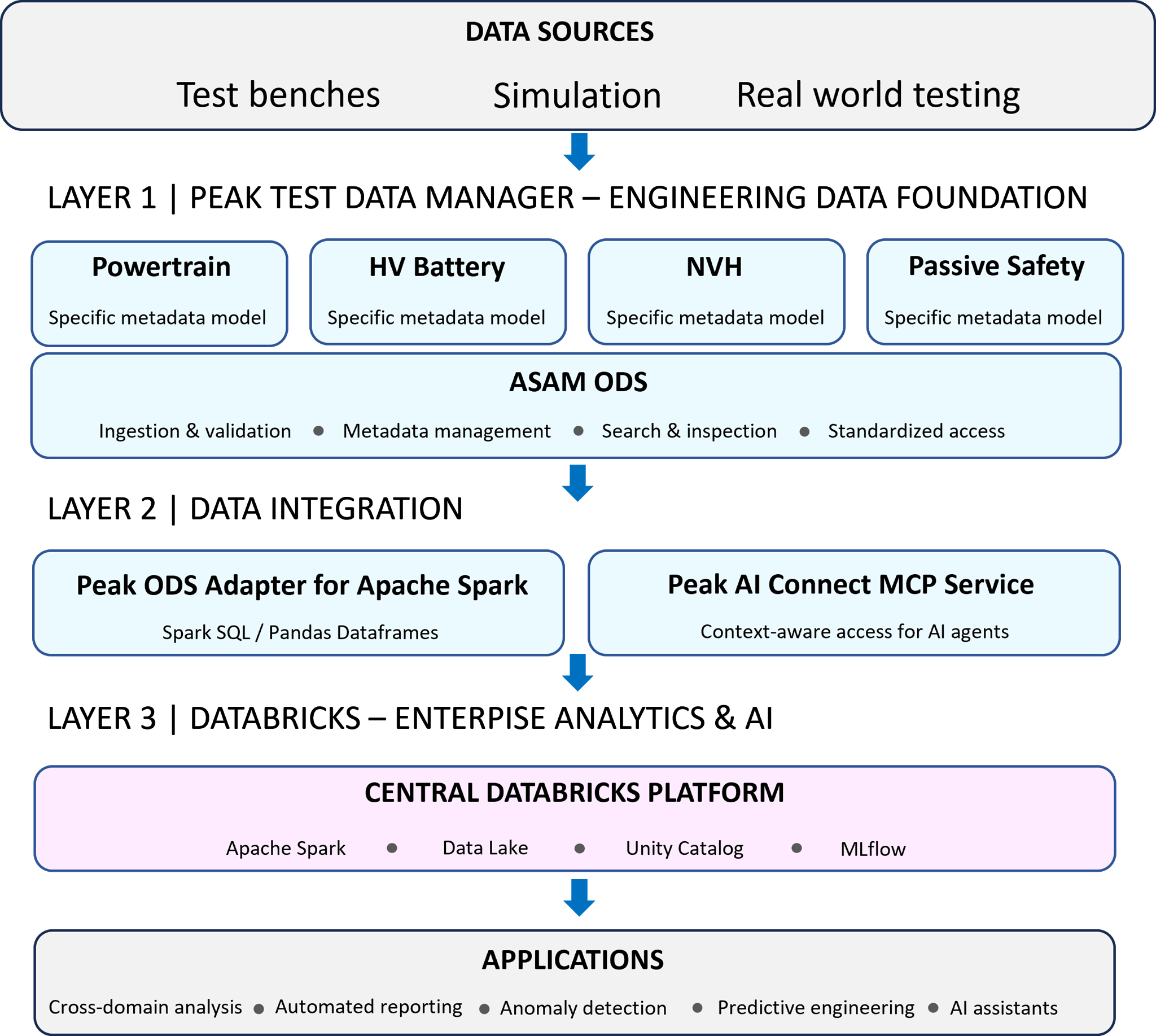
Conceptual reference architecture. The depicted domains and analytical use cases illustrate the reusable design;
individual deployments and connections depend on project configuration.
Business impact: A stronger foundation for engineering insight
One foundation, many test domains
The platform brings different test domains into a shared data management strategy without losing their technical specificity. Domain-specific metadata models preserves the meaning of individual measurements, while common access mechanisms make it easier to find, interpret and reuse results across organizational boundaries.
Lower integration effort and greater flexibility
Reusable ingestion, validation, metadata and access capabilities reduce the need to implement core data management functions repeatedly within each analytics project. Teams can evolve their analytical workloads independently of the underlying test systems, and onboard new sources through established mechanisms.
Scalable analysis without indiscriminate data duplication
Direct access based on Spark, combined with configurable data transformations, allows data provisioning to be tailored to specific analytical requirements. It is not always necessary to copy entire raw datasets into the analysis environment: targeted subsets and derived information can be processed exactly where they are needed and where they provide added value.
A practical route toward AI-enabled engineering
AI applications depend on access to trustworthy and well-described information. By retaining engineering context in the data foundation and exposing it through standardized interfaces, the architecture reduces the need for each new AI workflow to reconstruct the meaning of test data independently.
Why Peak Solution
Peak Solution combines long-standing experience in ASAM ODS-based test data management with mature, reusable software components and integration expertise. Its approach preserves investments in existing test and analysis tools, supports open standards and provides a foundation that can grow with new test domains and analytical requirements.
The takeaway
The global automotive implementation demonstrates that a modern Engineering Data & AI Platform does not have to be built from scratch. PeakTDM manages the engineering data complexity at its source while Databricks scales the analytics where it creates value. Together, they connect operational test environments with enterprise-wide innovation.
Build AI on an engineering data foundation that already works.
Connected solutions
The Right Components. The Right Solution. For Your Engineering Challenges.
Peak Test Data Manager
Stop searching for test data. Start turning it into engineering value. Transform scattered measurement data into a trusted, accessible, and AI-ready engineering asset.
Peak ODS Server
Store and access measurement data through open ASAM ODS models and standardized APIs
Peak ODS Adapter for Apache Spark
Connect your test data with scalable big-data environments and analytic platforms.
Peak AI Connect
Connect governed test data to AI-assisted analysis workflows through Peak AI Connect MCP Server, with engineers retaining control of results.
